
Rio Carnival Services >> 
Go for the experience of a life-time!

Sambodromo

Recommended by Lonely Planet!
Rio Carnival in Rio de Janeiro Buy Tickets
 
Rio Carnival in Rio de Janeiro Hotel Only Packages
 
Rio Carnival in Rio de Janeiro Air-Inclusive Packages

Home Packages Hotels Airfare New Year's Carnival Contact
Rio Carnival Tickets 2009 Guide Samba Parade Costumes Sambodromo Accommodation
Sambodromo
  Next ›
Sambodromo sectors and tickets
The Sambodromo (also known in English as Sambadrome or Sambodrome) is the "stadium" of samba. It consists of the Parading Avenue (the samba run-way) and several independent concrete structures for the spectators (the so called sectors) along both sides of the Parading Avenue.
The Sambodromo was designed by Brazil's world-famous architect, the modernist Oscar Niemeyer. It had been purpose-built for the Samba Parade and inaugurated in 1984. Being made of concrete, it seems a bit dated for the post-modern eyes of today and feels derelict if not ugly, surrounded only by favelas, serving only little cultural events, during the year.
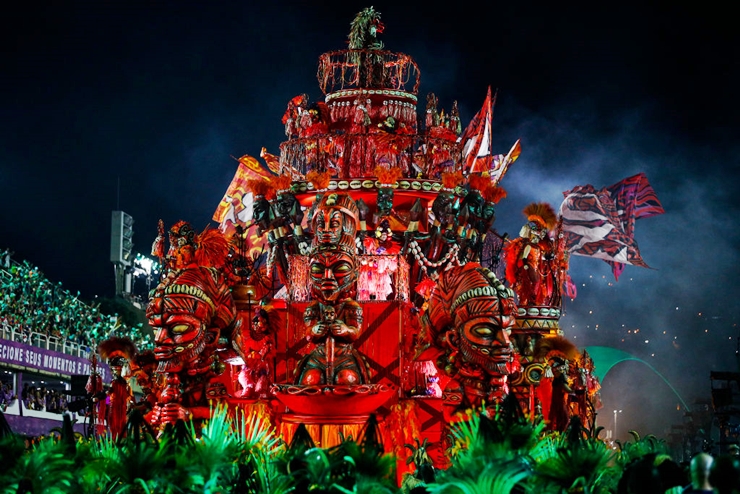
However, it comes to life and is truly magnificent and overpowering being lit up with special effects on Samba Parade nights, filled with thousands of cheering spectators and surrounded by many other thousands of people who could not get in.
It can seat around 70,000 people, which is already far too few for the ever growing Rio Carnival Parade. However, since it is under protection, it cannot be rebuilt nor extended.

Location
The Sambodromo is located at the recognized birthplace of samba. It begins at Avenida Presidente Vargas, near Praça Onze and ends in Rua Frei Caneca. The large square at the end of it, crowned by an idiosyncratic and very memorable large concrete M, is called the Apotheosis Square. The Avenue was named Professor Darcy Ribeiro since it was chosen by Vice-Governor Darcy Ribeiro to move the Samba Parade to, from the city center. It is 700m (half a mile) long.

Amenities

There are snack bars, refreshment stands and restrooms in each Sambodromo sector. In addition, everybody has access to a promenade behind the bleachers within the Sambodromo which is lined with restaurants, ice-cream stands, souvenir shops with more restrooms.

Safety

The Sambodromo on Samba Parade days is considered to be the safest place in South America. There is a very high concentration of international celebrities, politicians and royalties among the crowd. The Sambodromo is surrounded by huge fences which no-one can pass without using the gates and being checked for both commercial and safety reasons.

What to take

Be prepared that it is only fast food that is available in the Sambodromo. So we suggest having your dinner before setting off. You could take plastic containers with beverages and some food such as sandwiches and fruits. Objects made of polystyrene, bottles, glasses, firecrackers and fireworks are forbidden. Umbrellas are not a good idea, as they can easily get in the way of other people's view of the Parade.
As the show is extremely long and goes on until sunrise, some people take little mattresses and/or pillows to sit and even have a nap on.
You can take some toilet tissue as in the later hours it might run short in the bathrooms.
Some people take binoculars/theatre glasses.
You can take any type of still camera or normal video cameras (however professional video cameras are not allowed) etc., it is totally safe inside the Sambodromo. But be warned - only show them after you already checked in and be careful with anything valuable outside.

How to dress

Wear whatever you prefer. There are no rules not even standards what to wear for the Samba Parade (bear in mind that Rio people go even to weddings and funerals in colorful bermudas). People and celebrities in the boxes will dress up, however. In the Grand Stand sectors, informal street style rules. Use very light clothing as it is usually hot throughout the night and dark colors, not to get too dirty. A raincoat should be considered for the eventuality of a summer shower nevertheless if it rains, vendors will surely have them on sale in the Sambodromo.

When to arrive

Doors open at 17.00. Some already queue up for it to get the best seats in the sectors without allocated seats, which are considered to be the ones near the front.
There is a little welcome show at 20.00 with King Momo opening the night passing through the Sambodromo.
An average person truly enjoys and generally watches 3-5 samba schools. Thus, to arrive only around 22.00-23.00 is not a bad idea, particularly considering that that´s when the atmosphere starts to peak.


Buy your tickets
Tickets explained
FAQ
Rehearsals

Sambodromo Sambadrome Sambodrome

Sectors

Big, numbered, concrete buildings/structures along the samba run-way within the Sambodromo. The odd-numbered ones are all on the one side and the even-numbered on the other.
Most sectors (3, 4, 5, 7,9 and 11) have grand stand seats and have boxes in front.
Sector 1 only has grand stand seats and is in the area where the schools organize themselves for the Parade, with bad views. Tickets for this sector are not sold but given by the schools.
Sector 2 has covered suites on 3 floors (A, B and C-being on the top).
Grand Stand Sector 4 has restricted views (not seeing the paraders right from the beginning). It has great atmosphere however with great acoustics, being right in front of the drummer's niche. The boxes in front are excellent with full views of the whole Parade, Sector 2 not being in the way like for the bleachers.
Sector 6 and 13 have grand stand seats which are very cheap due to the fact that the view is bad being far behind. There are also numbered chairs in front of these sectors.
Sector 9 is the tourist sector which means that tickets for there are mainly sold abroad and are priced significantly higher. In this sector all seats are numbered. You might feel there quite isolated from the Brazilians and the "party".


Seat types
There are two types of Sambodromo seats: grand stand seats and numbered seats (in open or covered boxes/suites and on numbered chairs).

Grand Stand seats
Grand stand seats (bleachers or "arquibancadas") are on big concrete steps. There are no allocated seats within the sectors (with the exception of sector 9) and you can choose how high you want to get. You can also move at any time to another part/level of your sector. To watch the Parade from a higher position gives a better idea of the schools as a group and more perspective of the whole Parade. Whereas moving closer, you can appreciate more the costume details and the paraders' samba. Most people stand up to dance and here, being so close together with thousands of Brazilians, you will really experience what carnival actually means to them. The price difference between these sectors reflects what the market thinks about the view from that particular section of the Parading Avenue. The most expensive ones are around half-way and just a bit towards the end of the avenue.
The best options are Sector 7, 11 or 5.

 
Boxes/Suites


Box/Suite tickets are for numbered seats within the allocated box/suite in a particular sector.

There are two types - covered suites and open front-boxes.

Covered suites are the most excusive Sambodromo tickets offering the best views and the most comfort.
The best ones are the suites in sector 2, on 3 floors (A, B and C-being the top floor). They hold 12 people. There are more covered boxes in between sector 3, 5, 7 and 9, holding 24 spectators in A boxes and 20 in B boxes.

Front boxes
(called "frisas") have 6 numbered chairs and a small coffee table (no windows to fight for). They are along the Avenue right on the samba run-way, in front of the sectors 3, 4, 5, 7, 9 and 11.

The Drummers' niche
The drummers of every school stop, perform and play in the drummers' niche (between Sector 9 and 11) where the atmosphere is the most heated and intense. The front boxes in front of Sector 4 are located just opposite, offering the best acoustics and full view of their performance. Sector 11 also offers great acoustics and hot atmosphere.

How to get to the Sambodromo

The best and easiest way is by subway/metro or hailing a taxi on the street just when needed. Many companies offer special transfer services but timing is impossible on Samba Parade days and you might get very annoyed having to wait for hours. Try to avoid taking busses
Your route to the Sambodromo will depend on your seating sector as there is no connection between the two sides of the Sambodromo on Samba Parade days.


Taxi

Best to hail one as there are many in the streets and you won´t have to wait when no-one can predict traffic times. Tell the driver in advance your sector. The taximeter or an agreement with the driver sets the price of the journey. There is a little extra tariff to leave the Sambodromo. Ask before getting in (and negotiate) but it should only set you back R$30-50 (app. US$20-30).
There are 2 dedicated taxi companies which are exclusively serving the Sambodromo on Samba Parade days and have a good fleet of cars. They cost a bit more than other taxis (about R$60) but the advantage is that they will take you right inside your own sector.
Even-numbered sectors
Coopatur - Tel: 2573-1009 / 3885-1000
Odd-numbered sectors
Coopertramo - Tel:2560-2022 / 2560-1474

 
Subway

It goes uninterruptedly all round the clock on Carnival days until 23.00 on Tuesday, at 5 minute intervals during the night. It is safe on Carnival days and leaves you very close to the Sambodromo when all other traffic comes to a still-stand.

Even-numbered sectors
Get off at "Praça Onze" station. Once outside the station, turn twice to your right and then walk straight on. For sectors 4 and 6, take Rua Carmo Neto and walk on to Av. Salvador de Sá. You will see the Sambodromo soon.

Odd-numbered sectors
Get off at "Central" station. Then walk following the crowd to the Sambodromo, approximately 700 meters (half a mile), going past the schools' floats and Samba Land.


Museum

There is a small (about the size of a suburban family home) carnival museum at the Sambodromo which is free of charge and is open from 11 to 5 Tuesday to Sunday. It is located downtown on Rua Marques de Sapucai, the entrance being from Rua Frei Caneca. It has exhibits telling the story of Carnival and samba. Several actual costumes are also on display.


Sambodromo Visits

Like all stadiums and being ring-fenced, entry to the Sambodromo is usually only possible with tickets for some event. However it opens its doors and offers free entry to the grand stand seats in almost all sectors on rehearsal days which take place in the Sambodromo on the weekends before Rio Carnival.


Destinations | Carnival | New Year's | Air | Airpass | Packages | Eco Adventures | Cruises | Hotels | Excursions | Get our Bid

About Us | Why Book with Us | Insurance | Download Forms | Terms & Conditions | Customer Service | Group Travel | Contact Us