
Rio Samba Schools

Rio Samba Schools

Rio Samba Schools Buy Tickets

Rio Carnival Tickets 2009 Guide Samba Parade Costumes Sambodromo Contact


The Rio Samba School Guide


Read this page to learn about and understand how the Rio samba schools work. It explains, how you can go to a samba school night, gives their samba night (rehearsal) details and full addresses.

The Samba Schools are associations or social clubs, representing a particular neighborhood. They

  • provide entertainment through popular dance nights, just like clubs do
  • prepare for and compete annually in the Samba Parade

Samba School Beija Flor 
 Click to see photos

BEIJA-FLOR

Pracinha Wallace Paes Leme 1025 - Nilópolis
Tel: 2791-2866
Samba nights: Thursdays 21:00
Colors: blue and white
Established in 1948
2009 Samba Song

'Beija Flor' means 'Humming Bird' which is a beloved and omnipresent bird in the Rio region. The school is based outside of Rio (in a place called Nilopolis), however it is currently ranked the highest among all Rio samba schools. It has achieved the reputation of being the best school by the combination of an outstanding and unparalleled artistic and organizational management with the strong determination to win. It is the only school with a whole team of Carnival Designers (currently 5 of them) whereas most other schools only have one. It imposes strict rules and has the highest expectations towards all of its parading members. It began its recent winning streak in 1998 and won again in 2003, 2004, 2005 and 2007. If it did not it has been at least close to winning in all recent years. It is well-known for its creative extravagance and powerful colors. 

Samba School Grande Rio 
 Click to see photos

GRANDE RIO

Colégio São José,Av. Presidente Kennedy - Duque de Caxias - Tel: 2560-8037
Samba nights: Fridays 22:00
Colors: red, green and white
Established in 1988
2009 Samba Song

Grande Rio is one of the newest, however currently one of the most successful members of the Special Group, having come close to winning in all the last 5 years. It represents Caxias, a satellite town of Rio. It is particularly famous for its unprecedented protest parade in 2001 for an altogether fairer judging process. Lots of media celebrities support and parade with them.

Samba School Imperatriz Leopoldinense 
 Click to see photos

IMPERATRIZ LEOPOLDINENSE

Rua Professor Lacê 235 – Ramos
Tel: 2560-8037
Samba nights: Sundays 20:00
Colors: green, white and gold
Established in 1959
2009 Samba Song

Three-time winner in a row (in 1999, 2000 and 2001 - 'coincidently' in the very same years when the School's President was also heading the Judging Committee) which is the current record only challenged by Beija-Flor. Its success is due to its technically excellent performances and the School's long-time female Carnival Designer, Rosa Magalhães with her idiosyncratic fairy-tale like artistic creations.

Samba School Mangueira 
 Click to see photos

MANGUEIRA

Rua Visconde de Niterói 1072 - Mangueira
Tel: 3872-6786 / 3872-6787 / 2567-4637
Samba nights: Saturdays 22:00
Colors: green and pink
Established in 1928
2009 Samba Song

Brazil's most popular samba school due to its old tradition, a very strong support community and the most successful samba hall. It was the winner of the first Samba Parade held in the Sambodromo and has been ranked very high year by year ever since for its consistently strong performance. It is the oldest (although not the first) Rio samba school.

Samba School Mocidade 
 Click to see photos

MOCIDADE

Rua Coronel Tamarindo 38 - Padre Miguel
Tel: 3332-5823
Samba nights: Saturdays 22:00
Colors: green and white
Established in 1955
2009 Samba Song

It is one of the oldest samba schools in Rio, with its history of more than 50 years. It is well-known for its futuristic creations such as the one and only flying parader the Avenue has ever seen. Similarly to some other old names like Estácio, Portela and Imperio Serrano, it currently lives from its history (once it was really famous for its percussionists) however it fails to capitalize on its old tradition (like Mangueira does) and usually does not even score among the first 6 to be able to return on Champions' Saturday.


Samba School Portela 
 Click to see photos

PORTELA

Rua Clara Nunes 81 – Madureira
Tel: 2489-6440
Wednesdays 20:00
Samba nights: Fridays 22:00
Colors: blue and white
Established in 1923
2009 Samba Song

It is one of the oldest schools despite of several name changes in the past, only its symbol, the eagle, remaining unchanged. It is considered to be the oldest Rio samba group however not the oldest school. It traditionally used to be also one of the very best schools for a long time, winning 21 times which is the absolute record. However those days have long gone and it has lost its excellence ever since the 1980s. It has recently only managed to remain in the Special Group because of its history. It lacks real leadership now and nowadays its name is equivalent with corruption.

Samba School Porto da Pedra 
 Click to see photos

PORTO DA PEDRA

Rua Lúcio Tomé Feteira 290, Vila Lage - São Gonçalo
Tel: 2203-2705 / 2291-9445
Samba nights: Wednesdays 20:00
Colors: red and white
Established in 1978
2009 Samba Song

It was originally a part of soccer club established by a teen street gang. A relative new-comer both as a school and also in the Special Group (only among the elite since 1995). It has achieved its quick success due to huge investments from its sponsors buying very well-known carnival designers from its competitors. It is based in in the suburbs of Niteroi, across the bay from Rio.

SALGUEIRO

Rua Silva Teles 104 - Tijuca
Tel: 2238-9226
Samba nights: Saturdays 22:00
Colors: red and white
Established in 1953
2009 Samba Song

It is a truly elitist school (some call it racist) the name being equivalent with celebrities. It was, originally, actually among the first schools to show-case the achievements of the Afro-Brazilians in stark contrast to its current middle-class fan club. Salgueiro became really famous in the 1960s for its outstanding samba dance performers. It has a very popular samba hall, being close to the city center in one of the safest areas (compared to the other schools based on the hills in the slums). Every year, it uses its symbol, the fire, in its parade.

Samba School Imperio Serrano 
 Click to see photos

IMPÉRIO SERRANO

Av. Ministro Edgard Romero 114 - Madureira
Tel: 2489-8722 / 2489-9656
Samba nights: Saturdays 22:00
Colors: green and white
Established in 1947
2009 Samba Song

It is one of the very few schools in South Rio (Zona Sul). It has only joint the Special Group for this year and its future is quite uncertain, too, not being a great favorite by anyone in the know. It usually addresses some social issues through its themes.

Samba School Unidos da Tijuca 
 Click to see photos

UNIDOS DA TIJUCA

Clube dos Portuários, Av. Francisco Bicalho 47 – São Cristóvão
Tel: 2263-9836 / 2516-2749
Samba nights: Fridays and Saturdays 20:00
Colors: yellow and blue
Established in 1931
2009 Samba Song

This is the 3rd oldest Rio samba school. However, it became really noticed again only in 2004, as a surprise to everyone, with its very creative and innovative artistic work which is viewed as controversial by some. It is the only school paying homage to Brazil's background as a Portuguese colony. Its samba hall is very popular among gay men.

Samba School Vila Isabel 
 Click to see photos

VILA ISABEL

Av. 28 de Setembro 382 - Vila Isabel
Tel: 2578-0077 / 2576-4120
Samba nights: Tuesdays 20:00, Saturdays 22:00
Colors: blue and white
Established in 1946
2009 Samba Song

A very old, traditional school which almost went into oblivion, only lingering in the Access Group for a long time until recently when it re-joint the Special Group in 1995, with an astonishing championship straight after, in 1996, when it hired one of the most energetic up-and-coming carnival designers. However its has lost its outstanding designer and with him might have gone the quick fame, too.

Samba School Viradouro 
 Click to see photos

VIRADOURO

Av. do Contorno 16, Barreto - Niterói
Tel: 2628-7840
Samba nights: Tuesdays 20:00, Saturdays 22:00
Colors: red and white
Established in 1946
2009 Samba Song
It represents Niteroi, the city across the bay from Rio. It has joined the elite Special Group in the late 1980s. It is considered to be the school of the masses. It is, nevertheless, now an excellent, well organized and really creative school, which is always worthwhile to watch parade (always met with big cheers by the crowds), although it only won once. It is particularly famous for its percussionists, which traditionally scores 10 year by year.

The best Rio Samba Schools
The 12 schools in the Special Group

Rio Samba Schools


Samba Parade
The schools compete in the samba parades
Rio Samba Parade

What is it like?
Photos
Venue - Sambodromo
Buy your tickets
What kind of ticket?
Take part and parade
2009 Schedule
Rehearsals
Costumes
Results & Ranking


According to their two functions, the Rio samba schools usually have two physical locations

  • the samba halls, which work like huge dance clubs for all folks (the young and the aged) playing live samba music by the schools' percussion bands. You will also find the schools' main administrative center and president at these locations
  • their production units where the floats and some of the costumes are produced. Since 2005, all of the principle Rio samba schools in the Special Group have their production facilities at the same location, called Samba City, which is open to all visitors.

The samba schools represent the community spirit of a neighborhood, which is usually a particular shanty-town (favela). They bring a sense of community and belonging. The schools have a huge impact on their neighborhoods, being the best organized entities in the slums, with thousands of people joining the rehearsals, the samba nights and carnival preparations. They are often politically involved, too. They are absolutely essential parts of Rio's life and culture. Everyone truly from Rio supports a football team and a samba school.

Do not think of the samba schools as colleges where they will teach you how to dance samba. They are not teaching institutions as their name suggests and do not offer samba classes. However you can attend any of their samba nights and learn how to samba just by watching the others. The origin of the name samba school comes from the fact, as legend suggests, that the early sambistas used to rehearse in an empty lot near a teachers' college. "We also teach! Here the students learn to breathe and live samba!"

There are over 70 samba schools in Rio de Janeiro and they all parade during the 4 days of Carnival. They have to pick themes, write music and lyrics, make costumes and floats and practice all year to succeed in their parades. They are subject to a strict hierarchy and are organized into 6 competitive leagues. They are the Special Group, Group A, B, C, D and E. The first three groups parade in the Sambodromo. All other samba schools parade on the streets and are free to watch and to join in.

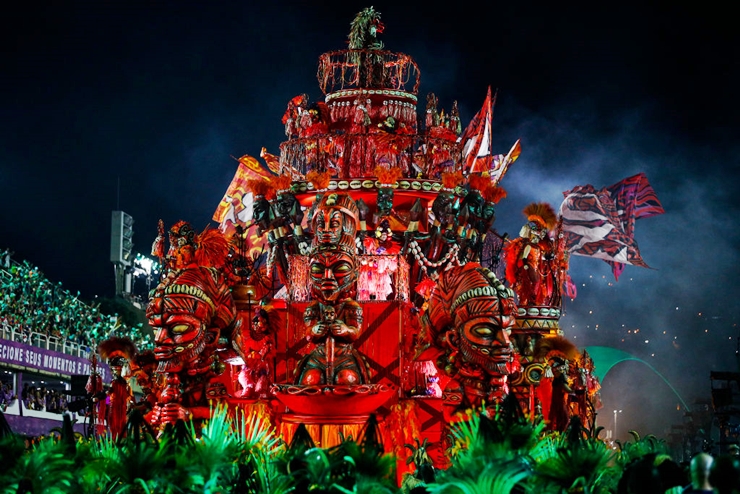
The biggest, most spectacular and leading 12 schools form the Special Group. They create a pageant with 3,000-5,000 people to compete in the Samba Parade in the Sambodromo on Carnival Sunday and Monday. See their 2009 Parade Schedule.

Each year a school is downgraded from the Special to the Access Group (also called Group A), which comprises the 10 less successful schools which also parade in the Sambodromo, on Carnival Saturday. And visa-versa, the best school of the year in Group A joins he Special Group in the following year.

The lowest rated schools parading in the Sambodromo belong to the Base Group (Group B), They are smaller and less spectacular, each school having approximately 1,500 participants.

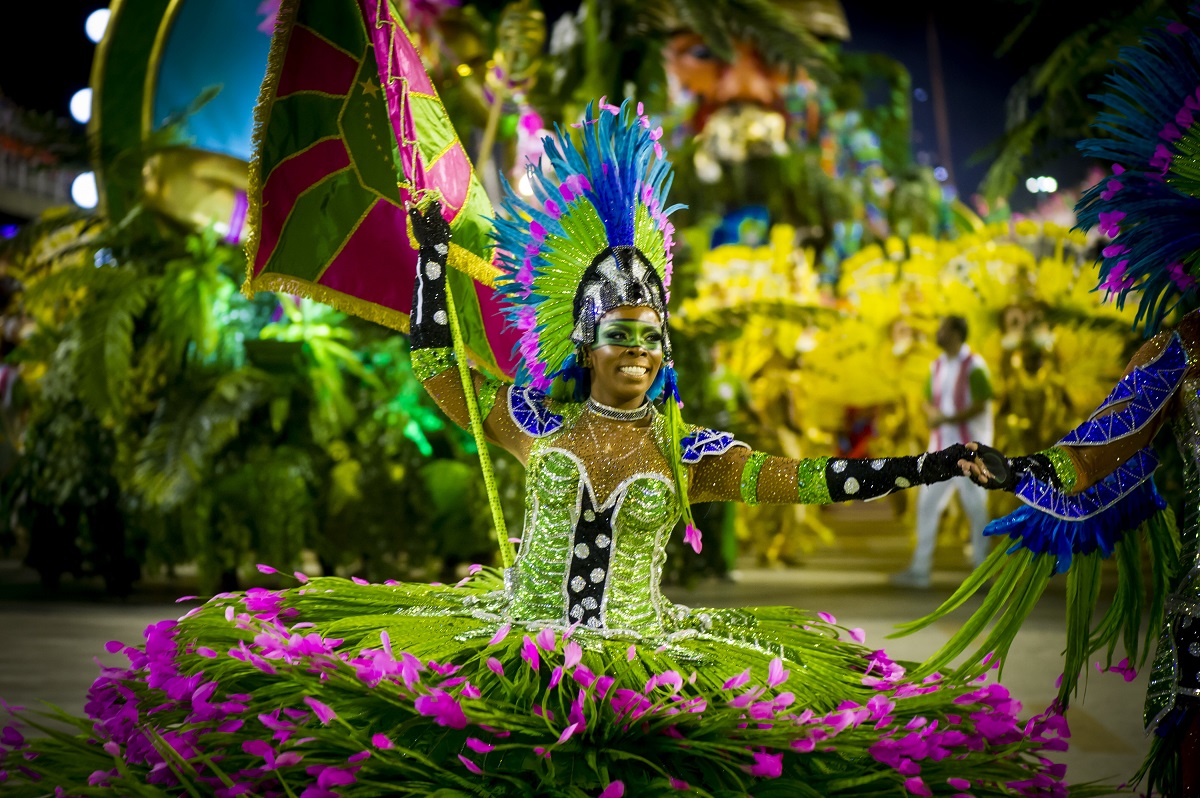
Each samba school has its own distinctive colors (of its flag) and costume style. The color scheme is reflected in may parts of a school's parade.

The schools raise money from ticket sales for their samba nights, television broadcasts and dance events. Some of the money given by members and sponsorships comes from illegal gambling. They are a true mixture of big business and big fun.


SAMBA SCHOOL HISTORY

Carnival has been celebrated in Brazil and in Rio de Janeiro for centuries, but samba schools first took their place in Rio Carnival only in the 1920s.

At the end of the 19th century, immigrants from Bahia state brought with them the tradition of playing candomble and dancing a bahian dance called the samba. In the slums of downtown Rio, a place referred to as 'Little Africa', they established a number of religious houses devoted to religious ceremonies where they played and danced the early forms of samba.

However African religions were illegal in the Catholic Brazil, and these roots of samba remained invisible to the white elite for a long time.

The samba schools' parading structure originates from the groups parading during Carnival in the 19th century. They already had some special set--up, including the Vanguard Commission, a chosen theme, floats and the flag bearing couple, all essential parts of today's samba schools.

The first group to call itself a samba school was a group known as Deixa Falar, which came from the district of Estácio, on the hill above Praça Onze, which is considered the cradle of samba. They called themselves samba school because they met right next door to a local children's school.

Deixa Falar and Mangueira were both founded at the end of the 1920's, Deixa Falar first, in 1926, and Mangueira soon after, in 1928. Deixa Falar was disbanded and later refounded as Estácio de Sá; so Mangueira can claim that it is the oldest samba school, however not the first.

Deixa Falar paraded for the first time on Praça Onze in 1929. In 1930 there were already 5 schools parading including Mangueira and Vai Como Pode, later known as Portela. The parade of the samba schools had become a contest, which Deixa Falar won in 1930 and 1931. By 1932 there were 19 schools parading. In 1933 the parade started to be sponsored by the biggest Brazilian media group 'O Globo', which established a list of 4 marking criteria for the judges.

Many of the Rio de Janeiro samba schools were originally part of a soccer club in the area where they were founded, such as Porto da Pedra.

In the last few years Rio Branco, the main financial street downtown has become the principal place for the carnival bands and groups to parade in over carnival weekend, although there are parades in almost all parts of the city at that time. The street becomes packed with groups of revelers from mid afternoon to the small hours of the following morning, starting from the Cinelândia end of the street. You can also find  many street bands around Lapa, all through Carnival.


Samba Nights

The samba schools offer samba nights at their samba halls, open to anyone. Going to one is the best way to make contact with the real samba and learn it. The nights are totally informal and very well attended, a bit like a mega club with people of all ages, with lots of dancing and boozing.

Such a night is definitely an experience not to be missed and which won't be forgotten. On these samba nights, the school's samba song of the year is being played over and over again to teach it in preparation for their Carnival parade.

You can go to the samba night of any school. Three of the best known ones, Mangueira, Unidos da Tijuca and Salgueiro, are located within a reasonable cab ride from the South End (Zona Sul).

Other samba halls are in the distant suburbs and not a place to wander about without someone who knows his way around. Some of them are very far away, even outside of Rio and can be quite rough.

We recommend going to Mangueira which has the biggest, safest and most famous hall with many tourists and lots of security (even so you might be a bit intimidated if not shocked, at first). A note of warning - the samba halls are in very poor areas, often on the borders of the slums so don't go flashy, dress right down and do not have anything valuable with or on you. However do go!

People usually arrive much later than the advertised starting time, usually well after midnight. Plan to arrive anytime after 23:30. Go by taxi (for safety reasons). There will also be plenty of them outside when you are finally ready to go home.

There is usually an entrance fee of between R$5.00 and R$30.00 (about US$10).


Go with us for the experience of a life-time!

Breathe and live samba